


Page 28 - Nexia SAB&T Property and Tax Guide 2025
P. 28
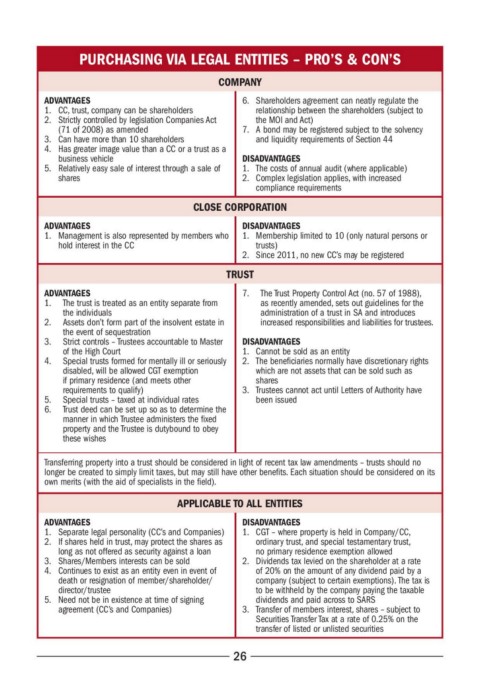
PURCHASING VIA LEGAL ENTITIES – PRO’S & CON’S
                            COMPANY
      ADVANTAGES               6.   Shareholders agreement can neatly regulate the
      1.  CC, trust, company can be shareholders  relationship between the shareholders (subject to
      2.   Strictly controlled by legislation Companies Act   the MOI and Act)
        (71 of 2008) as amended  7.   A bond may be registered subject to the solvency
      3.   Can have more than 10 shareholders  and liquidity requirements of Section 44
      4.   Has greater image value than a CC or a trust as a
        business vehicle       DISADVANTAGES
      5.   Relatively easy sale of interest through a sale of   1.   The costs of annual audit (where applicable)
        shares                 2.   Complex legislation applies, with increased
                                 compliance requirements
                         CLOSE CORPORATION
      ADVANTAGES               DISADVANTAGES
      1.   Management is also represented by members who   1.   Membership limited to 10 (only natural persons or
        hold interest in the CC  trusts)
                               2.   Since 2011, no new CC’s may be registered
                             TRUST
      ADVANTAGES               7.   The Trust Property Control Act (no. 57 of 1988),
      1.   The trust is treated as an entity separate from   as recently amended, sets out guidelines for the
         the individuals         administration of a trust in SA and introduces
      2.   Assets don’t form part of the insolvent estate in   increased responsibilities and liabilities for trustees.
         the event of sequestration
      3.   Strict controls – Trustees accountable to Master   DISADVANTAGES
         of the High Court     1.  Cannot be sold as an entity
      4.   Special trusts formed for mentally ill or seriously   2.   The beneficiaries normally have discretionary rights
         disabled, will be allowed CGT exemption   which are not assets that can be sold such as
         if primary residence (and meets other   shares
         requirements to qualify)  3.   Trustees cannot act until Letters of Authority have
      5.   Special trusts – taxed at individual rates  been issued
      6.   Trust deed can be set up so as to determine the
         manner in which Trustee administers the fixed
         property and the Trustee is dutybound to obey
         these wishes
      Transferring property into a trust should be considered in light of recent tax law amendments – trusts should no
      longer be created to simply limit taxes, but may still have other benefits. Each situation should be considered on its
      own merits (with the aid of specialists in the field).
                       APPLICABLE TO ALL ENTITIES
      ADVANTAGES               DISADVANTAGES
      1.   Separate legal personality (CC’s and Companies)  1.   CGT – where property is held in Company/CC,
      2.   If shares held in trust, may protect the shares as   ordinary trust, and special testamentary trust,
        long as not offered as security against a loan  no primary residence exemption allowed
      3.  Shares/Members interests can be sold  2.   Dividends tax levied on the shareholder at a rate
      4.   Continues to exist as an entity even in event of   of 20% on the amount of any dividend paid by a
        death or resignation of member/shareholder/  company (subject to certain exemptions). The tax is
        director/trustee         to be withheld by the company paying the taxable
      5.   Need not be in existence at time of signing   dividends and paid across to SARS
        agreement (CC’s and Companies)  3.   Transfer of members interest, shares – subject to
                                 Securities Transfer Tax at a rate of 0.25% on the
                                 transfer of listed or unlisted securities
                              26

